GENERAL SEMINAR: Prof. Sixto Malato Rodriquez, Plataforma Solar de Almería-CIEMAT, Spain
ABOUT Prof. Sixto Malato Rodriquez
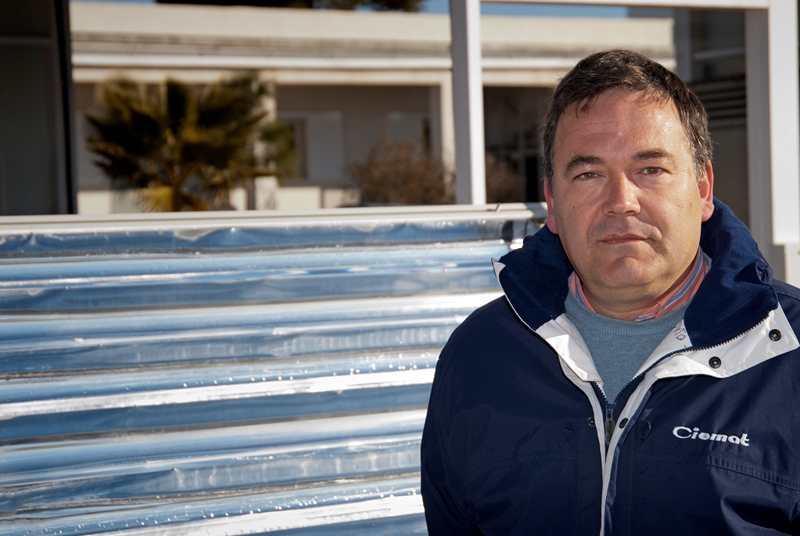
Sixto Malato is full Professor of Research of the Spain Ministery of Science and Universities, working at Plataforma Solar de Almeria (www.psa.es). Prof. Malato is at the forefront of advanced wastewater treatment, especially in the development of photoreactors. Some of his milestones are: i) fundamentals for solar photoreactors; ii) methodology for combination of AOPs with aerobic treatments; iii) combination of membrane processes with AOPs, iv) treatment methods for the removal of contaminants of emerging concern from wastewater; and more recently v) production of hydrogen using solar photoreactors.
He has carried out top-level research, basic for the EU regulation on water reuse (UE 2020/741, applied since 26 June 2023) and the recent Directive (EU) 2024/3019 of 27 Nov. 2024, concerning urban wastewater treatment. More recently, his contributions are significant in photoreforming of organic matter for photofuel production.
He is between the most cited authors in Spain, with an H factor of 93 (http://www.scopus.com) and a continuous rise in citations >32,000 citations in June 2025). He has co-authored >320 publications (>200 in Q1) in indexed journals (JCR), and more than 400 contributions to Int. conferences. Director or Co-Director of CIESOL, http://www.ciesol.es, Joint Research Center (Univ. Almería-CIEMAT), since 2006. Director of Plataforma Solar de Almeria 2012-2017. Prof. Malato has been “chairman” of the most important events in the area: “3rd European conference on environmental applications of advanced oxidation processes” (EAAOP3) and “10th European Meeting on Solar Chemistry and Photocatalysis: Environmental Applications (SPEA10).
Broad participation in EU projects (>30 projects for >15 M€, many of them as leader). has supervised 22 PhDs (3 more under preparation). Editor of 40 special issues in different high IF journals: Appl. Catal. B: Environ., Chem. Eng. J., J. Hazar. Mat., Cat. Today and others.
The Jury’s Grand Prix of “European Grand Prix for Innovation Awards”. 11 December 2004, Mónaco. http://www.european-grandprix.com/index_en.htm. Jaime I Price (Most important in science in Spain) in Environmental Protection, 2011.
Application of solar photocatalysis to wastewater treatment and photosynthetic processes.
S. Malato
Plataforma Solar de Almería – CIEMAT, 04200 Tabernas, Almería, Spain
Sixto.malato@psa.es
Advanced Oxidation Processes (AOPs) are efficient technologies for water treatment in terms of degradation of pollutants and inactivation of pathogens. In AOPs, the generation of highly reactive radicals allows attaining the oxidation of a great variety of pollutants. A wide range of advanced treatment methods have been investigated including consolidated and not intensively implemented AOPs. The presentation will evaluate their efficiency in the removal of contaminants, advantages and drawbacks, possible obstacles to the application and technological limitations with mid to long terms perspectives. It will also explore the state of the art and latest progress in photoreactors for solar AOPs for water treatment including decontamination of conventional biorecalcitrant wastewaters and elimination of contaminants of emerging concern. The overview will also show how to focus specific wastewaters and discriminate between different AOPs to avoid inefficient applications.
Pilot-scale test results for the complete removal of a plethora of contaminants and microcontaminants have been quite satisfactory. Results reinforce the idea that treatment of extremely low concentrations of contaminants (as contaminants of emerging concern), requires different operating concepts from the application of photocatalysis to high-organic-load industrial wastewaters. The key matter is the design and operation of photoreactors accordingly to the wastewater to be treated. Despite the limitations of the process, the efficiency of the technology for the treatment of wastewater has prompted its investigation at pilot-scale in combination with other technologies as biotreatment and membrane processes. Also, different solar photoreactors have been proposed for applying photocatalysis, trying to take into account the specific needs of the process. In this sense, Raceway Pond Reactors, have arisen as an interesting and feasible scaling-up option for treating municipal effluents, being well-known solar photoreactors based on compound parabolic collectors, more suitable for the treatment of bio-recalcitrant industrial wastewaters with high organic load.
The interest in renewable H2 production sources, with H2 as an energy carrier, is growing. It would be also commented the first approaches to another application of solar photocatalysis, the potential combination of H2 generation with simultaneous water decontamination, as a proof-of-principle study of the potential application of solar photocatalysis as a single technological solution for the water-energy nexus. With this technology, clean hydrogen fuel is produced at the same time as wastewater is treated in anoxic conditions, eliminating highly recalcitrant contaminants and disinfecting it for reuse.