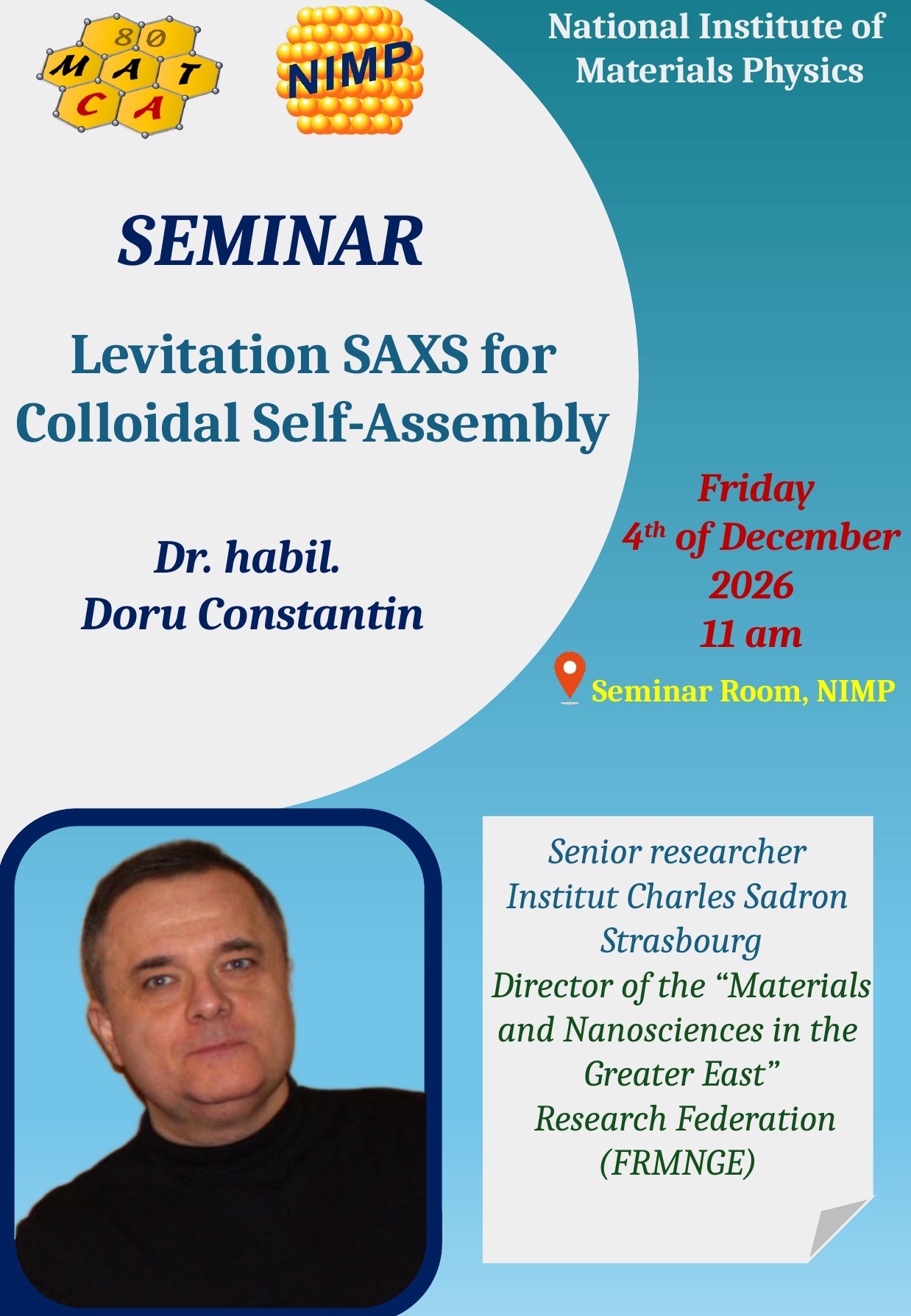
Speaker: Dr. habil. Doru Constantin
Affiliation: Institut Charles Sadron, CNRS and Université de Strasbourg, France
📅 Friday, 4th of December 2026
🕚 11:00
📍 National Institute of Materials Physics
Atomistilor 405A, Magurele — Seminar Room
Organised by: Laboratory of Catalytic Materials and Catalysis (Lab 80)
Seminar Description
Drying colloids are ubiquitous in natural (soils, aerosols) and manmade systems (from food and cement to nanomaterials), involving physical processes that occur over broad spatial and temporal scales. Thus, evaporation-induced self-assembly (EISA) has emerged as a scalable and versatile route to fabricate nanomaterials with controlled architectures and emergent collective properties. However, detailed studies of the kinetic pathways by which nanoparticles (NPs) evolve from dilute dispersions into ordered superstructures during EISA are scarce.
One of the reasons for this lack of knowledge is experimental difficulty: time scales of drying in a capillary can be prohibitively slow, and the presence of solid interfaces can induce inhomogeneities, e.g., the coffee-ring effect, or specific textures1. Allowing levitated droplets of solution (or dispersion) to dry solves both these problems by keeping the material in a limited volume exposed to the X-ray beam, but under limited confinement. That is why levitation SAXS (LevSAXS) has been used recently to investigate phase diagrams of colloidal dispersions of 1D and 2D nanoparticles, showing that LevSAXS opens up the time dimension and gives access to much higher concentrations than those reachable via classical preparation methods.
In this work, we follow by LevSAXS the evolution of two kinds of colloidal suspensions and reveal the complex paths they follow as the concentration increases:
- Plasmonic silver nanorods dispersed in cetyltrimethylammonium chloride (CTAC) solutions form highly ordered superlattices upon drying. We show that the key parameter governing superlattice formation is the initial CTAC concentration, outweighing nanoparticle concentration and shape effects. Surfactant plays a dual role: first, micelles induce depletion attractions2 that drive nucleation and growth, but CTAC gelation at later stages induces structural arrest3. These findings are directly relevant to improving the design of plasmonic metamaterials and NP self-assemblies in a broad sense.
- Lepidocrocite titanate nanoribbons (NRs) are a recently discovered form of TiO2, with very high anisotropy and specific surface4. As concentration increases the system becomes more structured and the NRs fuse into extended 2D sheets that stack in a swollen 3D lamellar phase. Finally, this phase expels water and counterions to yield a condensed state consisting of titanate sheets alternating with counterion monolayers5. This unconventional pathway across nanomaterial dimensionality opens the way towards controlling the orientational and positional order of the objects in order to fully exploit their exceptional structural and photocatalytical properties.
References
- W. Chaâbani et al., Prismatic Confinement Induces Tunable Orientation in Plasmonic Supercrystals, ACS Nano 18, 9566-9575 (2024).
- R. Nag et al., Depletion-Induced Tunable Assembly of Complementary Platonic Solids, Nano Letters 24, 16368-16373 (2024).
- C. Hotton et al., Evaporation-Induced Phase Transitions in Free-Standing Plasmonic Nanoparticle Assemblies, Nano Letters 26, 8274-8281 (2026).
- S. Boukhris et al., Structural Analysis of Colloidal Titania‐Based Ribbons and Their Self‐Assembly upon Drying, Small Structures 6, 2500017 (2025).
- S. Boukhris et al., In situ monitoring the self-assembly and stacking of colloidal titanate ribbons, under review.
About the Speaker
Doru Constantin earned their undergraduate degree and PhD at the École Normale Supérieure de Lyon, followed by a Marie Curie Fellowship at the X-ray Research Institute of the University of Göttingen (2002-2005). They obtained their habilitation at Université Paris-Sud in 2011 and have been a senior researcher at the Institut Charles Sadron in Strasbourg since 2020. He also serves as Director of the “Materials and Nanosciences in the Greater East” research federation (FRMNGE), which brings together approximately 1,500 researchers from 31 institutes and laboratories in eastern France specialising in materials science, nanostructures and nanoscale phenomena.
His research uses advanced synchrotron-based techniques to study the growth and assembly of inorganic nano-objects and interactions between components in colloidal systems. They also investigate the linear and nonlinear optical properties of noble metal nanoparticles.